WAAD
BAHJAT
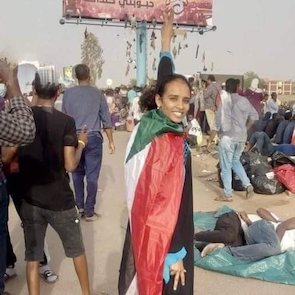
Women's rights defender, blogger, and member of the Umbda Resistance Committee who was arrested, ill-treated, and convicted on charges of public annoyance after livestreaming police harassment of women at a petrol station in Khartoum.
- Country
- Sudan
- Role
- Blogger
- Sentence
- Six months in prison (suspended) plus a fine of 10,000 Sudanese pounds (approximately 22 euros).
Approved
The arrest, and what followed.
Background and Work
Waad Bahjat is a women's rights defender, blogger, and member of the Umbda Resistance Committee, a grassroots organisation advocating for civil and economic rights in Sudan. The resistance committees emerged during the popular uprising that began in December 2018 and led to the overthrow of President Omar al-Bashir in April 2019. These neighbourhood-level networks sustained the protest movement and continued to organise for accountability, economic justice, and human rights under the transitional government established after Bashir's fall.
Bahjat uses digital platforms to document and challenge discrimination and abuses of power, particularly those affecting women. Her work centres on making visible the everyday harassment and violence that women face from state actors in public spaces. On 8 November 2020, she witnessed police officers and members of the Sudanese Armed Forces harassing a group of women at a petrol station in Al-Amarat, a neighbourhood in Khartoum. She began broadcasting the scene live on her personal Facebook account, narrating what she observed.
The Arrest
On 8 November 2020, a police officer and an officer of the Sudanese Armed Forces arrested Waad Bahjat while she was livestreaming. She was detained overnight and subjected to threats and ill-treatment. She was released the following day, 9 November 2020, pending trial. Authorities charged her with multiple offences under the Sudanese Criminal Act: defamation, insulting a public servant exercising judicial proceedings, publishing false news, public annoyance (Article 77), and use of criminal force (Article 143).
Legal Proceedings
The first hearing took place on 3 December 2020 before the Khartoum Criminal Court. On 10 January 2021, during her second hearing, the court dismissed the charges of defamation, insulting a public servant, and publishing false news. However, it maintained the charge of public annoyance and added the charge of use of criminal force. Bahjat pleaded not guilty and refuted the accusations.
On 31 March 2021, the Khartoum Criminal Court convicted Waad Bahjat and sentenced her to six months in prison, suspended, and a fine of 10,000 Sudanese pounds (approximately 22 euros). After the verdict, she was detained for several hours in the police station attached to the court and released the same day following payment of the fine. Bahjat announced her intention to appeal the conviction.
Context and Continuing Risks
The prosecution of Waad Bahjat forms part of a broader pattern of judicial harassment targeting human rights defenders in Sudan, particularly women who document abuses by security forces. Despite the transitional government's commitments to reform and accountability, legacy laws from the Bashir era continue to be used to criminalise dissent and silence critical voices. The charges brought against Bahjat—public annoyance, use of criminal force—are vague offences frequently deployed to prosecute activists and journalists.
The case illustrates the risks faced by defenders who use digital tools to expose misconduct. Bahjat's conviction sends a chilling message to others who might document police violence or harassment, particularly acts targeting women. Her appeal challenges not only the conviction itself but the broader legal framework that permits the criminalisation of legitimate human rights work.
Sources on file with HuMENA EditorialReading time · 6 minutes
The prosecution punishes not the harassment she documented, but the act of documenting it.HuMENA Editorial · 2026
Take action.
Ways to act on Waad Bahjat's case — chosen contextually from country, status, and your location.
Compiled by HuMENA's Sudan research team from primary documentation, public filings, family-supplied legal documents, and confidential partner reporting. Editorial responsibility: HuMENA Editorial Board.
Editorial sign-off · published