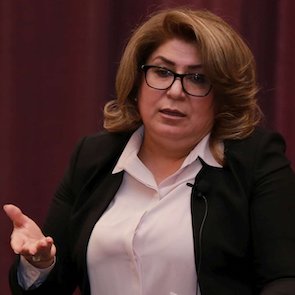
Tanya Darwish
Director of Rasan Organisation; woman human rights defender working on women's and LGBTIQ+ rights in the Kurdistan Region of Iraq.
as of 06 Jun 2026
in Iraq
The court closed Rasan based solely on its rainbow logo, concluding it reflected activities in the field of 'homosexuality'—yet cited no illegal conduct.HuMENA Editorial
Issued Saturday, 6 June 2026
§ 01Background and the caseEditorial narrative
Tanya Darwish led Rasan Organisation, the only LGBTIQ+ rights group in Iraqi Kurdistan, until a court ordered its closure over a rainbow logo. She faces criminal charges and has been subjected to sexualised defamation campaigns.
Background and Work
Tanya Darwish is a woman human rights defender and the director of Rasan Organisation, a civil-society group based in Sulaymaniyah in the Kurdistan Region of Iraq. Rasan was founded to promote and defend the rights of women and LGBTIQ+ people through a combination of direct support services and public advocacy. The organisation provided legal assistance, social support, and psychological counselling to individuals facing discrimination, violence, and exclusion. It also conducted awareness-raising campaigns aimed at shifting public attitudes and challenging harmful stereotypes.
Rasan was the only organisation in the Kurdistan Region of Iraq dedicated to supporting and advocating for the LGBTIQ+ community. Its work filled a significant gap in a region where state institutions offer little protection and where social hostility toward sexual and gender minorities is widespread. Women and LGBTIQ+ individuals who sought help from Rasan often had nowhere else to turn.
Escalating Complaints and Criminal Charges
In April 2019, a petition bearing 530 signatures was submitted against Rasan staff, accusing them of "spreading hatred with the aim of promoting illegal actions" under Article 403 of the Iraqi Penal Code. The petition was the first of several attempts to shut down the organisation through legal complaints.
In February 2021, Omar Gulpi, a member of the Kurdistan Regional Parliament, filed a formal complaint against Rasan, invoking the same penal-code provision and accusing the organisation of "violating public integrity and decency." The complaint provided the legal basis for subsequent judicial proceedings against the organisation and its staff.
On 16 June 2021, Tanya Darwish received a phone call from police informing her that she, current staff members, and former employees of Rasan were under investigation. The Department of Non-Governmental Organisations had lodged a complaint alleging that they had engaged in illegal activities. The charge—spreading hatred with the aim of promoting illegal actions—carries a prison sentence of up to two years. Darwish's lawyer advised her not to attend the police interrogation, warning that she and others might be detained if they appeared. The following day, the lawyer requested a postponement of the interrogation, citing Darwish's health condition.
The Closure of Rasan Organisation
On 31 May 2023, a court of first instance in Sulaymaniyah issued an order to close Rasan Organisation. The ruling was based entirely on the organisation's logo, which featured rainbow colours. Court-appointed legal experts concluded that the logo "fully reflects [the organisation's] activities in the field of 'homosexuality'." The judgment did not cite any illegal activities carried out by the organisation. Throughout the trial, Rasan was never informed that its logo was the subject of judicial scrutiny.
Rasan filed an appeal against the closure order, but the organisation is prohibited from resuming any of its human rights activities while the appeal is pending. The forced dissolution left women and LGBTIQ+ individuals in the Kurdistan Region without access to the specialised legal, social, and psychological services that Rasan had provided.
Gender-Based Attacks and Online Harassment
Tanya Darwish has been subjected to persistent harassment throughout her work with Rasan. She was targeted in an online sexualised defamation campaign that used fabricated or distorted personal information to attack her credibility and reputation. The campaign sought to undermine her standing as a human rights defender by exploiting social stigma around women's sexuality and autonomy.
Sexualised defamation is a form of gender-based violence used systematically against women human rights defenders in Iraq and across the region. These campaigns are designed not only to silence individual defenders but to deter other women from engaging in public advocacy, particularly on issues related to gender and sexuality.
Context and Pattern of Persecution
The judicial closure of Rasan and the criminal charges against its staff are part of a broader pattern of persecution targeting LGBTIQ+ rights defenders and activists in Iraq. Since the beginning of 2023, there has been a marked increase in hostile rhetoric, legal restrictions, and violence directed at LGBTIQ+ individuals and anyone perceived to support them. This hostility has been fuelled by statements from political leaders, armed factions, and religious authorities across Iraq, including in the Kurdistan Region.
The Kurdistan Regional Government and Iraqi federal authorities have increasingly invoked vague morality provisions in the penal code to criminalise human rights work related to gender and sexuality. These provisions are applied selectively and without clear legal standards, creating an environment in which defenders are vulnerable to arbitrary prosecution and judicial harassment.
Rasan's closure and the criminalisation of Tanya Darwish and her colleagues illustrate the precarious position of those who defend the rights of marginalised communities in Iraq. The state's use of judicial mechanisms to shut down civil-society organisations and prosecute their staff reflects a systemic effort to eliminate spaces for dissent and advocacy on issues deemed politically or socially sensitive.
§ 02Documented chronology6 events on file
-
01 Apr 2019Monday
other Petition filed against Rasan staff A petition with 530 signatures accused Tanya Darwish and Rasan staff of 'spreading hatred with the aim of promoting illegal actions' under Article 403 of the Iraqi Penal Code.
-
01 Feb 2021Monday
other Parliament member files complaint Omar Gulpi, a member of the Kurdistan Regional Parliament, filed a formal complaint against Rasan Organisation, accusing it of violating public integrity and decency under Article 403.
-
16 Jun 2021Wednesday
other Police summon Darwish for interrogation Tanya Darwish received a call from police informing her that she, her staff, and former Rasan employees were under investigation following a complaint by the Department of Non-Governmental Organisations. Her lawyer advised her not to attend, fearing detention.
-
17 Jun 2021Thursday
other Lawyer requests postponement Darwish's lawyer asked police to postpone the interrogation, citing her health condition.
-
31 May 2023Wednesday
verdict Court orders Rasan Organisation closed A court of first instance in Sulaymaniyah ordered the closure of Rasan Organisation based solely on its rainbow-coloured logo. The court concluded the logo reflected activities in the field of 'homosexuality' but cited no illegal conduct.
-
31 May 2023Wednesday
other Rasan files appeal Rasan Organisation filed an appeal against the closure order but remains prohibited from resuming its human rights activities while the appeal is pending.
§ 03Charges filed by the state2 on record
- 01Spreading hatred with the aim of promoting illegal actions under Article 403 of the Iraqi Penal Code
- 02Violating public integrity and decency
§ 05Documented violations6 categories
§ 06Editorial provenanceHuMENA Editorial Board
This case file was compiled by HuMENA's Iraq research team from primary documentation, public filings, family-supplied legal documents, and confidential partner reporting. Editorial responsibility rests with the HuMENA Editorial Board. Where dates or facts are uncertain, the record errs on the side of the source material and notes uncertainty in the live archive at humena.org.
- Generated
- Saturday, 6 June 2026
- Source dataset retrieved
- 2026-05-12
- Live record (canonical)
- https://dev.humena.org/defenders/tanya-darwish/
- Editorial sign-off
- HuMENA Editorial Board
§ 07Take-downs · corrections · partner submissions
HuMENA welcomes corrections, additions, and take-down requests from the defender, their family, or accredited representatives. Material discrepancies are typically addressed within 72 hours.
Editorial · editorial@humena.org
Take-downs & corrections · takedowns@humena.org
Partner submissions (confidential) · partners@humena.org