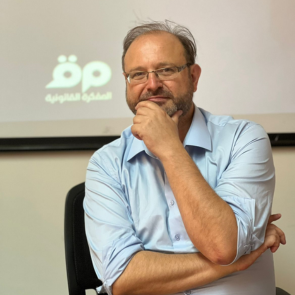
Nizar Saghieh
Human rights lawyer, legal researcher, and co-founder of the Legal Agenda; specialising in judicial independence, public property, the environment, and marginalised groups.
as of 06 Jun 2026
in Lebanon
The Council questioned him for four hours about his public criticism, which they called a campaign to undermine the Bar's national role.HuMENA Editorial
Issued Saturday, 6 June 2026
§ 01Background and the caseEditorial narrative
A founding member of the Legal Agenda, Nizar Saghieh faces disbarment proceedings for criticising amendments that require Bar approval before lawyers speak to the media.
Background and Work
Nizar Saghieh is a leading human rights lawyer and legal researcher in Lebanon. He co-founded the Legal Agenda, an independent platform that monitors legislation and public policy in Lebanon and across the Middle East and North Africa. The organisation has become a key resource for understanding how law shapes—and often undermines—social justice in the region.
Saghieh's work spans judicial independence, environmental protection, public property rights, and the legal status of marginalised groups including refugees, LGBTQI+ individuals, and workers. He has been instrumental in efforts to hold state institutions accountable, particularly since the August 2020 Beirut port explosion and the onset of Lebanon's economic and financial collapse in 2019. His legal analysis and advocacy have made him a prominent figure in civil society's demands for transparency and justice.
The Amendments to the Code of Ethics
On 3 March 2023, the Council of the Beirut Bar Association approved amendments to Articles 39, 40, 41, and 42 of the Lawyers' Code of Ethics. The revised provisions prohibit lawyers from participating in public legal debates, discussing pending cases, or engaging with any media—including television, radio, and social media—without prior written approval from the Bar president. The amendments also forbid criticism of Bar Council members, particularly during election periods.
The restrictions apply to all lawyers registered with the Beirut Bar Association. In Lebanon, membership in either the Beirut or Tripoli Bar Association is mandatory for practising law. Violations of the Code of Ethics can result in referral to the Disciplinary Board and sanctions ranging from reprimand to suspension or disbarment.
The amendments were adopted during a period of intensifying scrutiny of state officials implicated in the banking scandal and financial crisis. Human rights lawyers viewed the timing as an effort to silence legal advocates at a moment when public accountability was most urgent.
Summons and Interrogation
Saghieh publicly criticised the amendments, arguing that they violated lawyers' freedom of expression and their professional duty to inform the public. In response, the Council of the Beirut Bar Association summoned him on 28 March 2023 and again on 11 April 2023, without specifying the reasons for the summons.
On 20 April 2023, Saghieh appeared before the Council for a hearing that lasted four hours. Twelve Council members questioned him about his public statements, which they described as a campaign to cast doubt on the Bar's national role. Saghieh requested that his lawyers accompany him; the Council denied the request. He was interrogated alone.
The Council has not yet issued a decision. Saghieh faces potential sanctions including disbarment. The case has not been referred to the Disciplinary Board, raising concerns about due process and the Council's direct exercise of punitive authority.
Legal Challenge
Saghieh and thirteen other lawyers filed an appeal before the Beirut Court of Appeals, the body with jurisdiction over union-related disputes, challenging the Council's decision to impose the amendments. The appeal argues that the restrictions violate lawyers' freedom of expression and their ability to practise their profession.
The court held a hearing on 13 April 2023. A final decision was expected on 4 May 2023, though the outcome of the appeal remains unclear as of the time of documentation.
Broader Context
The Beirut Bar Association's actions against Saghieh are part of a wider pattern of retaliation against human rights lawyers in Lebanon. The Tripoli Bar Association has taken similar measures. In December 2022, its Disciplinary Council suspended lawyer Khalid Merheb for four months after he published social media posts criticising the Minister of Interior's anti-LGBTQI+ directive. More recently, lawyer Mohammed Sablouh, who represents torture victims and Syrian refugees, was informed that authorities were pressuring the Tripoli Bar to silence him over his documentation of human rights violations.
The escalation of disciplinary actions against lawyers coincides with ongoing investigations into senior officials implicated in Lebanon's financial collapse, including the Governor of the Central Bank and executives involved in the banking scandal. Human rights defenders view the Bar Associations' restrictions as part of a broader effort to limit legal accountability and public scrutiny during a period of systemic crisis.
§ 02Documented chronology5 events on file
-
03 Mar 2023Friday
other Bar adopts restrictive amendments The Council of the Beirut Bar Association approved amendments to the Lawyers' Code of Ethics requiring prior approval from the Bar president before any lawyer speaks to the media or participates in public legal debates.
-
28 Mar 2023Tuesday
other First summons without explanation The Council of the Beirut Bar Association summoned Nizar Saghieh without clarifying the reasons for the summons.
-
11 Apr 2023Tuesday
other Second summons The Council summoned Saghieh a second time, again without specifying the reasons.
-
13 Apr 2023Thursday
hearing Appeal hearing held The Beirut Court of Appeals held a hearing on the appeal filed by Saghieh and thirteen other lawyers challenging the Code of Ethics amendments.
-
20 Apr 2023Thursday
hearing Interrogation before Bar Council Saghieh appeared before the Council of the Beirut Bar Association for a four-hour interrogation about his public criticism of the amendments. His request to have his lawyers present was denied.
§ 03Charges filed by the state1 on record
- 01Violation of the Lawyers' Code of Ethics for publicly criticising amendments to the Code and allegedly undermining the Bar Association's national role
§ 05Documented violations5 categories
§ 06Editorial provenanceHuMENA Editorial Board
This case file was compiled by HuMENA's Lebanon research team from primary documentation, public filings, family-supplied legal documents, and confidential partner reporting. Editorial responsibility rests with the HuMENA Editorial Board. Where dates or facts are uncertain, the record errs on the side of the source material and notes uncertainty in the live archive at humena.org.
- Generated
- Saturday, 6 June 2026
- Source dataset retrieved
- 2026-05-12
- Live record (canonical)
- https://dev.humena.org/defenders/nizar-saghieh/
- Editorial sign-off
- HuMENA Editorial Board
§ 07Take-downs · corrections · partner submissions
HuMENA welcomes corrections, additions, and take-down requests from the defender, their family, or accredited representatives. Material discrepancies are typically addressed within 72 hours.
Editorial · editorial@humena.org
Take-downs & corrections · takedowns@humena.org
Partner submissions (confidential) · partners@humena.org