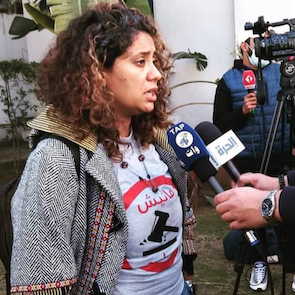
Meriem Bribri
Blogger and human rights monitor documenting police violence and civil rights violations in Tunisia.
as of 06 Jun 2026
in Tunisia
She was convicted for sharing a video of police violence and adding her own criticism — a telecommunications law was used to silence documentation of abuse.HuMENA Editorial
Issued Saturday, 6 June 2026
§ 01Background and the caseEditorial narrative
Meriem Bribri was sentenced to four months in prison and fined for sharing a video of police violence on Facebook. A telecommunications law was used to prosecute her criticism of security forces.
Background and Work
Meriem Bribri is a blogger and human rights monitor based in Sfax, in southeastern Tunisia. Her work centres on documenting violations of civil rights and abuses by state security forces. She has participated in youth-led protests challenging laws that restrict freedom of expression, and she uses social media to amplify evidence of police violence and to call for accountability.
In a country where the gap between constitutional guarantees and street-level enforcement has widened, Bribri represents a generation of digital defenders who use accessible technology to hold power to account. Her posts document incidents that official channels ignore or deny.
The Facebook Post and the Complaint
On 20 October 2020, Bribri reposted a video on her Facebook page. The footage, filmed in Nabeul, a city on Tunisia's northeastern coast, showed a security officer physically assaulting a civilian. Bribri added commentary criticising the violence used by some members of the security forces in the course of their duties.
The Tunisian Security Union, which represents police officers, filed a complaint against her with the General Prosecutor in Sfax. The union invoked Article 86 of the Telecommunication Code of 2001, a provision that criminalises the use of public telecommunications networks to "knowingly harm third parties or disrupt their peace." The statute carries a sentence of one to two years' imprisonment and a fine of 100 to 1,000 Tunisian dinars.
The Trial and Sentence
On 21 December 2021, the Court of First Instance in Sfax convicted Bribri under Article 86. The court sentenced her to four months in prison and a fine of 500 dinars. The prosecution was based solely on her having shared the video and criticised police conduct.
Bribri contested the validity of the proceedings. She was not provided with the case file detailing the evidence, notes, or formal charges against her. Fundamental judicial procedures were not respected. Her lawyer initiated an appeal on 22 December 2021.
Harassment and Threats
Following the conviction, Bribri faced harassment from security officers and members of the police union. Threats were made against her. The climate of intimidation intensified as her case moved through the appeals process.
The appeal hearing was scheduled for 28 September 2022 before the Sfax Court of Appeal.
Legal Context
Article 86 of Tunisia's Telecommunication Code has increasingly been used to prosecute human rights defenders who document and share evidence of abuses by security forces. The statute's vague language — "harming" or "disturbing" others via telecommunications networks — grants prosecutors and judges wide discretion to criminalise online speech, particularly criticism of state institutions.
Bribri's case is part of a broader pattern in which Tunisian authorities deploy telecommunications and cybercrime laws to silence those who expose police violence or challenge official narratives. The law functions as a tool of judicial harassment, punishing the messenger rather than addressing the abuse documented in the footage.
§ 02Documented chronology5 events on file
-
20 Oct 2020Tuesday
other Facebook post shared Bribri reposted a video on Facebook showing a security officer in Nabeul assaulting a civilian, adding commentary criticising police violence.
-
20 Oct 2020Tuesday
other Police union files complaint The Tunisian Security Union filed a complaint with the General Prosecutor in Sfax under Article 86 of the Telecommunication Code.
-
21 Dec 2021Tuesday
verdict Convicted by Sfax court The Court of First Instance in Sfax convicted Bribri under Article 86 and sentenced her to four months in prison and a fine of 500 dinars.
-
22 Dec 2021Wednesday
other Appeal lodged Bribri's lawyer initiated an appeal against the conviction.
-
28 Sep 2022Wednesday
hearing Appeal hearing scheduled An appeal hearing was scheduled before the Sfax Court of Appeal.
§ 03Charges filed by the state1 on record
- 01Knowingly harming or disturbing others via public telecommunications networks under Article 86 of the Telecommunication Code of 2001
§ 04Sentence
§ 05Documented violations6 categories
§ 06Editorial provenanceHuMENA Editorial Board
This case file was compiled by HuMENA's Tunisia research team from primary documentation, public filings, family-supplied legal documents, and confidential partner reporting. Editorial responsibility rests with the HuMENA Editorial Board. Where dates or facts are uncertain, the record errs on the side of the source material and notes uncertainty in the live archive at humena.org.
- Generated
- Saturday, 6 June 2026
- Source dataset retrieved
- 2026-05-12
- Live record (canonical)
- https://dev.humena.org/defenders/meriem-bribri/
- Editorial sign-off
- HuMENA Editorial Board
§ 07Take-downs · corrections · partner submissions
HuMENA welcomes corrections, additions, and take-down requests from the defender, their family, or accredited representatives. Material discrepancies are typically addressed within 72 hours.
Editorial · editorial@humena.org
Take-downs & corrections · takedowns@humena.org
Partner submissions (confidential) · partners@humena.org