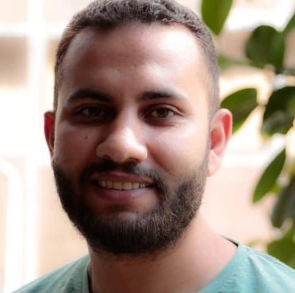
Ibrahim Ezz El-Din
Architectural planning engineer and researcher at the Egyptian Commission for Rights and Freedoms, working on the right to housing and forced evictions.
as of 06 Jun 2026
in Egypt
An engineer who documented forced evictions, disappeared for 167 days, then held without trial for nearly three years on terrorism charges.HuMENA Editorial
Issued Saturday, 6 June 2026
§ 01Background and the caseEditorial narrative
An engineer who documented forced evictions, Ibrahim Ezz El-Din was arrested in June 2019, disappeared for 167 days, then held in pre-trial detention for nearly three years before receiving a presidential pardon in April 2022.
Background and Work
Ibrahim Ezz El-Din trained as an architectural planning engineer. His professional expertise in urban planning led him to the Egyptian Commission for Rights and Freedoms, one of Egypt's few remaining independent human rights organisations, where he worked as a researcher documenting forced evictions and violations of the right to housing.
His work focused on communities facing demolition orders, families displaced by infrastructure projects, and informal settlements targeted for clearance without adequate notice or compensation. In a country where an estimated 40 per cent of the urban population lives in informal housing, this documentation carried significant risks.
Arrest and Enforced Disappearance
On 12 June 2019, Egyptian security forces arrested Ibrahim Ezz El-Din in the Mokattam area of Cairo and took him to an unknown location. No arrest warrant was shown to him or his family. No notification was given of where he was being held or on what grounds.
The Egyptian Commission for Rights and Freedoms filed a case with the Administrative Court of Cairo seeking information about his whereabouts. The first hearing was scheduled for 3 September 2019 and later rescheduled to 16 November 2019. Throughout this period, Ibrahim Ezz El-Din remained disappeared.
He reappeared on 26 November 2019, 167 days after his arrest, brought before the State Public Prosecution in Cairo. Prosecutors immediately linked him to case No. 488 of 2019, charging him with spreading false news, belonging to a terrorist group, and misuse of social media. The Public Prosecution ordered his detention for fifteen days pending investigation.
Prolonged Pre-Trial Detention
Between December 2019 and April 2022, Ibrahim Ezz El-Din was held in prolonged pre-trial detention. Prosecutors renewed his detention repeatedly in cycles of fifteen and forty-five days. On 4 December 2019 the Supreme Public Prosecution renewed his detention for fifteen days. On 4 March 2020 it renewed for another fifteen days. On 5 May 2020 the Criminal Court of Cairo renewed his detention alongside three other human rights defenders for forty-five days.
On 27 December 2020, the Criminal Court of Cairo issued an order for his release. The order was never implemented. Instead, on 2 January 2021, the State Public Prosecutor added him to a new case, No. 1018 of 2021, on charges of belonging to a terrorist organisation, and ordered his detention for an additional fifteen days. The cycle of renewals continued.
Detention Conditions
Ibrahim Ezz El-Din was held in pre-trial detention facilities in Cairo. During the initial months of his enforced disappearance, his family had no access to him and no information about his location or condition. After his formal appearance before prosecutors in November 2019, he entered the regular detention system, though family visit access remained restricted and subject to frequent denials.
Release
On 12 April 2022, Ibrahim Ezz El-Din was released as part of a series of pardons issued by President Abdel Fattah el-Sisi. The pardon was unrelated to the December 2020 court order that had never been enforced. He had spent nearly three years in detention, the vast majority of it without trial, for research work on housing rights that posed no threat to public safety.
§ 02Documented chronology9 events on file
-
12 Jun 2019Wednesday
arrest Arrested in Cairo Security forces arrested Ibrahim Ezz El-Din in the Mokattam area of Cairo and took him to an unknown location.
-
03 Sep 2019Tuesday
hearing Administrative Court hearing rescheduled The Administrative Court of Cairo rescheduled the first session of the case filed by ECRF to determine his whereabouts to 16 November 2019.
-
26 Nov 2019Tuesday
reappearance · before · prosecutor Reappeared before State Public Prosecutor Ibrahim Ezz El-Din appeared before the State Public Prosecution in Cairo, 167 days after his enforced disappearance. He was immediately charged and ordered detained for fifteen days.
-
04 Dec 2019Wednesday
hearing Pre-trial detention renewed The Supreme Public Prosecution of Cairo renewed his preventive detention for fifteen days.
-
04 Mar 2020Wednesday
hearing Detention renewed for fifteen days The Supreme Public Prosecution renewed his pre-trial detention for an additional fifteen days.
-
05 May 2020Tuesday
hearing Detention extended for forty-five days The Criminal Court of Cairo renewed his detention alongside three other human rights defenders for forty-five days.
-
27 Dec 2020Sunday
other Release order issued but not implemented The Criminal Court of Cairo issued a release order for Ibrahim Ezz El-Din, but authorities did not implement it.
-
02 Jan 2021Saturday
hearing Added to new case, detention extended The State Public Prosecutor linked him to case No. 1018 of 2021, charging him with belonging to a terrorist organisation, and ordered detention for fifteen days.
-
12 Apr 2022Tuesday
release Released following presidential pardon Ibrahim Ezz El-Din was released as part of a series of pardons issued by President Abdel Fattah el-Sisi after nearly three years in detention.
§ 03Charges filed by the state4 on record
- 01Spreading false news
- 02Belonging to a terrorist group
- 03Misuse of social media
- 04Belonging to a terrorist organisation (case No. 1018 of 2021)
§ 05Documented violations5 categories
§ 06Editorial provenanceHuMENA Editorial Board
This case file was compiled by HuMENA's Egypt research team from primary documentation, public filings, family-supplied legal documents, and confidential partner reporting. Editorial responsibility rests with the HuMENA Editorial Board. Where dates or facts are uncertain, the record errs on the side of the source material and notes uncertainty in the live archive at humena.org.
- Generated
- Saturday, 6 June 2026
- Source dataset retrieved
- 2026-05-12
- Live record (canonical)
- https://dev.humena.org/defenders/ibrahim-ezz-el-din/
- Editorial sign-off
- HuMENA Editorial Board
§ 07Take-downs · corrections · partner submissions
HuMENA welcomes corrections, additions, and take-down requests from the defender, their family, or accredited representatives. Material discrepancies are typically addressed within 72 hours.
Editorial · editorial@humena.org
Take-downs & corrections · takedowns@humena.org
Partner submissions (confidential) · partners@humena.org