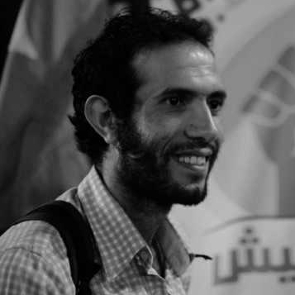
Haytham Mohamadeen
Labour rights lawyer providing pro-bono legal aid to workers; member of El-Naddim Centre for the Rehabilitation of Victims of Violence.
as of 06 Jun 2026
in Egypt
He spent over four years in pre-trial detention on terrorism charges that were never tried in court.HuMENA Editorial
Issued Saturday, 6 June 2026
§ 01Background and the caseEditorial narrative
Haytham Mohamadeen is a labour lawyer who spent over four years in preventive detention on terrorism-related charges. He was arrested in 2018, briefly released, then re-arrested in 2019 and held until his release in September 2022.
Background and Work
Haytham Mohamadeen is a labour rights lawyer and human rights defender based in Egypt. He dedicated his practice to providing pro-bono legal representation to workers facing dismissal, wage theft, and unsafe working conditions. He was a member of El-Naddim Centre for the Rehabilitation of Victims of Violence, an Egyptian non-governmental organisation focused on combating torture and providing medical and legal support to victims of human rights violations.
His work placed him at the intersection of labour organising and human rights documentation in a country where independent trade union activity and criticism of state economic policy are increasingly criminalised. Lawyers who defend workers and document abuses have faced systematic targeting through Egypt's expanded state security apparatus.
First Arrest and Precautionary Measures
Mohamadeen was arrested in October 2018 and placed in pre-trial detention. On 29 October 2018, eighteen days after his arrest, the Criminal Chamber of the Fifth Compound Courts Complex ruled in his favour and ordered his release. He was not freed outright. Instead, on 19 November 2018, the Criminal Court of Cairo and the Supreme State Security Emergency Court imposed precautionary measures requiring him and nine other defendants in State Security Case No. 718/2018 to report to their local police stations twice weekly. The measures were renewed every forty-five days.
Re-Arrest and Enforced Disappearance
On 13 May 2019, Mohamadeen was summoned to Saf police station in Giza governorate. Authorities claimed he had violated the terms of his probation. When he presented himself at the station, police arrested him. He was held incommunicado, without access to his lawyer or family, for three days.
He reappeared on 16 May 2019 before the State Security Prosecution, which charged him with membership of a terrorist organisation. His detention was renewed every fifteen days. From August 2019 onward, renewals extended to forty-five days at a time. The cycle of renewal continued without trial for more than four years.
Brief Release Order and Immediate Appeal
On 27 November 2019, the Criminal Court of Cairo ordered Mohamadeen's release under precautionary measures. One day later, on 28 November 2019, the Appeals Court of Cairo accepted an appeal filed by the Public Prosecution. He remained in detention.
Prolonged Pre-Trial Detention
Mohamadeen's detention was renewed repeatedly throughout 2020. On 18 February 2020, the Criminal Court of Cairo extended his pre-trial detention for an additional forty-five days. On 6 May 2020, the same court renewed it again. No trial took place. The charges against him expanded to include "aiding a terrorist organisation to achieve its goals" and "misuse of social media."
Release
On 15 September 2022, the Presidential Pardons Committee announced that the Public Prosecution had decided to release forty-six prisoners held in preventive detention. Mohamadeen was among them. He had spent more than four years in pre-trial detention without being convicted of any crime. The terrorism-related charges were never adjudicated in open court.
Legal and Procedural Context
Egypt's Code of Criminal Procedure permits pre-trial detention for a maximum of two years. In practice, prosecutors routinely circumvent this limit by closing one case file and opening another with identical or expanded charges, a procedure known as "rotation" or "recycling." Defendants remain in detention across multiple case numbers without ever facing trial. The practice has been condemned by Egyptian and international human rights organisations as a form of arbitrary detention that renders legal maximums meaningless.
Mohamadeen's case exemplifies the use of terrorism charges and state security prosecution to neutralise labour organisers and legal defenders. His detention spanned more than four years, during which he was denied the right to a timely trial, subjected to enforced disappearance, and held under laws that grant prosecutors near-unlimited powers of renewal. His release in 2022 was administrative, not judicial; the charges were never withdrawn, and no court declared him innocent.
§ 02Documented chronology11 events on file
-
11 Oct 2018Thursday
arrest First arrest Mohamadeen was arrested and placed in pre-trial detention in State Security Case No. 718/2018.
-
29 Oct 2018Monday
release Court orders release The Criminal Chamber of the Fifth Compound Courts Complex ruled in his favour and ordered his release after eighteen days in detention.
-
19 Nov 2018Monday
other Precautionary measures imposed The Criminal Court of Cairo and the Supreme State Security Emergency Court imposed precautionary measures requiring him to report to his local police station twice weekly.
-
13 May 2019Monday
arrest Re-arrest and enforced disappearance Police arrested Mohamadeen at Saf station in Giza after summoning him on allegations of violating probation. He was held incommunicado for three days.
-
16 May 2019Thursday
reappearance · before · prosecutor Reappearance before prosecution Mohamadeen reappeared before the State Security Prosecution, charged with membership of a terrorist organisation. His detention began being renewed every fifteen days.
-
25 Aug 2019Sunday
hearing Detention renewal extended to 45 days The State Security Prosecution renewed his detention, shifting from fifteen-day to forty-five-day renewal cycles.
-
27 Nov 2019Wednesday
release Court orders conditional release The Criminal Court of Cairo ordered Mohamadeen's release under precautionary measures.
-
28 Nov 2019Thursday
other Prosecution appeals release order The Appeals Court of Cairo accepted the Public Prosecution's appeal against the release order. Mohamadeen remained in detention.
-
18 Feb 2020Tuesday
hearing Detention renewed The Criminal Court of Cairo renewed his pre-trial detention for an additional forty-five days.
-
06 May 2020Wednesday
hearing Detention renewed The Criminal Court of Cairo renewed his pre-trial detention for a further forty-five days.
-
15 Sep 2022Thursday
release Released from preventive detention The Presidential Pardons Committee announced the Public Prosecution's decision to release forty-six prisoners, including Mohamadeen, after over four years in pre-trial detention.
§ 03Charges filed by the state3 on record
- 01Membership of a terrorist organisation
- 02Aiding a terrorist organisation to achieve its goals
- 03Misuse of social media
§ 05Documented violations5 categories
§ 06Editorial provenanceHuMENA Editorial Board
This case file was compiled by HuMENA's Egypt research team from primary documentation, public filings, family-supplied legal documents, and confidential partner reporting. Editorial responsibility rests with the HuMENA Editorial Board. Where dates or facts are uncertain, the record errs on the side of the source material and notes uncertainty in the live archive at humena.org.
- Generated
- Saturday, 6 June 2026
- Source dataset retrieved
- 2026-05-12
- Live record (canonical)
- https://dev.humena.org/defenders/haytham-mohamadeen/
- Editorial sign-off
- HuMENA Editorial Board
§ 07Take-downs · corrections · partner submissions
HuMENA welcomes corrections, additions, and take-down requests from the defender, their family, or accredited representatives. Material discrepancies are typically addressed within 72 hours.
Editorial · editorial@humena.org
Take-downs & corrections · takedowns@humena.org
Partner submissions (confidential) · partners@humena.org