Al-Fadil Ismail
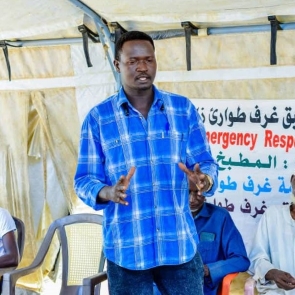
Economics graduate; volunteer with the Emergency Response Room in Zalingei; member of the Zalingei Resistance Committees Coordinating Body.
as of 06 Jun 2026
in Sudan
Awfy remains detained without charge, without legal process, and without explanation—held for helping his community survive a war.HuMENA Editorial
Issued Saturday, 6 June 2026
§ 01Background and the caseEditorial narrative
Al-Fadil Ismail volunteers with the Emergency Response Room in Zalingei, Darfur, and coordinates aid in his community. He was arrested from his shop by RSF forces and is held without charge.
Background and Work
Al-Fadil Ismail Adam Abdelbari graduated from the Faculty of Economics at El Geneina University and returned to his community in Zalingei, the capital of Central Darfur State. He ran a shop near the Grand Mosque in the city's main market, a hub where residents gathered for commerce and conversation in calmer times.
Awfy became known for his volunteer work with the Emergency Response Room in Zalingei's Kanjomiyya neighbourhood. These grassroots emergency cells emerged during Sudan's 2018–2019 revolution and evolved into vital community infrastructure after the 2021 military coup. When civil war erupted between the Sudanese Armed Forces and the Rapid Support Forces in April 2023, volunteers like Awfy became essential coordinators of survival—tracking displaced families, distributing food and medicine, and documenting attacks.
Awfy also served as a member of the Zalingei Resistance Committees Coordinating Body, a loose federation of neighbourhood-level organising groups that reject military rule and demand civilian governance. His role combined humanitarian logistics with civic organising, making him visible both to the community he served and to the armed forces that viewed such committees as threats.
The Arrest
On 5 November 2025, at approximately five o'clock in the afternoon, Rapid Support Forces soldiers arrested Awfy in the main market of Zalingei. The arrest took place near his shop, steps from the Grand Mosque, in a public area that would have been crowded at that hour. Witnesses reported that RSF personnel took him without explanation.
Awfy was driven to an RSF intelligence facility located in the Karank neighbourhood, housed in a building that previously served as a doctors' hostel and health insurance office. There he was interrogated. Later that same evening, he was transferred to Zalingei central prison, where he has remained ever since.
Detention Without Charge
As of 18 November 2025, no charges had been filed against Awfy. No formal complaint has been registered. No public statement has been issued by RSF authorities or any branch of Sudanese government explaining the grounds for his detention. His family has been given no information about when—or whether—he will face a court.
This pattern of arrest without legal process has become widespread in RSF-controlled areas of Darfur since the outbreak of war. Volunteers associated with resistance committees and emergency response networks have been detained, disappeared, and in some cases killed. The RSF views these civic structures as extensions of its rival, the Sudanese Armed Forces, or as obstacles to its territorial control.
Context: Darfur Under the RSF
The Rapid Support Forces, a paramilitary group that emerged from the Janjaweed militias of the early 2000s, controls much of Darfur as of late 2025. Its conduct during the current conflict has been marked by mass atrocities, including ethnic cleansing, sexual violence, and the systematic targeting of civilian infrastructure. Human rights defenders, doctors, and community organisers have been arrested, tortured, and executed.
Resistance committees like the one Awfy belonged to are descendants of the neighbourhood organising networks that toppled Omar al-Bashir's dictatorship in 2019. They reject both the RSF and the Sudanese Armed Forces, calling instead for civilian rule and accountability for war crimes. This stance has made them targets for both warring parties, but particularly for the RSF, which lacks any pretence of legal authority.
Legal and International Obligations
Sudan remains a party to the International Covenant on Civil and Political Rights and the African Charter on Human and Peoples' Rights, both of which guarantee the right to liberty and security of person, prohibit arbitrary detention, and require that anyone arrested be promptly informed of charges and brought before a judge. Sudan's own Interim Constitution of 2005, still nominally in force in some regions, provides similar protections.
The RSF operates outside any of these frameworks. It maintains detention facilities, conducts interrogations, and imprisons civilians without reference to law. Awfy's case is emblematic: arrest in public, transfer to an intelligence site, imprisonment without charge, and silence from the detaining authority.
§ 02Documented chronology3 events on file
-
05 Nov 2025Wednesday
arrest Arrested by RSF in Zalingei market Al-Fadil Ismail was arrested by Rapid Support Forces soldiers at approximately 5:00 p.m. in the main market of Zalingei, Central Darfur, near his shop by the Grand Mosque.
-
05 Nov 2025Wednesday
transfer Transferred to RSF intelligence facility Following his arrest, Awfy was taken to an RSF intelligence facility in the Karank neighbourhood, located in a former doctors' hostel and health insurance building, where he was interrogated.
-
05 Nov 2025Wednesday
transfer Moved to Zalingei central prison Later on the same day, after interrogation at the RSF intelligence site, Awfy was transferred to Zalingei central prison, where he has remained detained without charge.
§ 05Documented violations4 categories
§ 06Editorial provenanceHuMENA Editorial Board
This case file was compiled by HuMENA's Sudan research team from primary documentation, public filings, family-supplied legal documents, and confidential partner reporting. Editorial responsibility rests with the HuMENA Editorial Board. Where dates or facts are uncertain, the record errs on the side of the source material and notes uncertainty in the live archive at humena.org.
- Generated
- Saturday, 6 June 2026
- Source dataset retrieved
- 2026-05-12
- Live record (canonical)
- https://dev.humena.org/defenders/al-fadil-ismail/
- Editorial sign-off
- HuMENA Editorial Board
§ 07Take-downs · corrections · partner submissions
HuMENA welcomes corrections, additions, and take-down requests from the defender, their family, or accredited representatives. Material discrepancies are typically addressed within 72 hours.
Editorial · editorial@humena.org
Take-downs & corrections · takedowns@humena.org
Partner submissions (confidential) · partners@humena.org