FALEH
HAMMOUDI
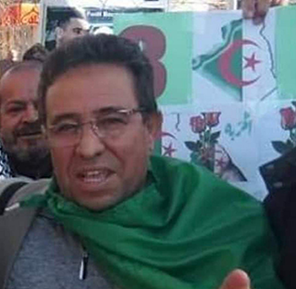
Head of the Tlemcen office of the Algerian League for the Defense of Human Rights, convicted to three years in prison for Facebook posts documenting migration and criticising state authorities.
- Country
- Algeria
- Role
- Human rights monitor
- Sentence
- Three years in prison and a fine of 100,000 Algerian dinars (approximately 628 euros).
Approved
The arrest, and what followed.
Background and Work
Faleh Hammoudi holds a prominent position in Algeria's civil-society infrastructure. He heads the Tlemcen office of the Algerian League for the Defense of Human Rights (LADDH), one of the country's oldest independent human rights organisations. He also serves as national secretary of the Autonomous National Union of Public Administration Staff (SNAPAP), where he leads the human rights and migration department.
His expertise centres on migration. Hammoudi monitors and documents migration flows from Algeria to the European Union, tracking both the policy environment and the lived experience of migrants. He is a member of the EuroMed Rights Migration and Asylum Working Group, contributing Algerian and Maghreb perspectives to regional advocacy.
Much of Hammoudi's documentation work takes place online. He uses social media to share information about migration routes, border policies, and the treatment of migrants by Algerian and European authorities. This public-facing work made him visible — and vulnerable.
The Arrest
On 19 February 2022, officers of the National Gendarmerie arrived at Hammoudi's home in Tlemcen. They searched the premises and confiscated his mobile phone and computer. He was placed under investigation and taken into custody.
The following day, 20 February 2022, Hammoudi appeared before the Public Prosecutor and was immediately brought to trial at the Tlemcen Court of Misdemeanours. The court convicted him of three offences: running and managing an unsanctioned organisation under Article 45 of the Law Governing Associations; insulting a statutory body under Articles 144 and 146 of the Algerian Penal Code; and deliberately publishing false news that could prejudice public security under Article 196 of the Penal Code.
All three charges related to posts Hammoudi had made on his Facebook account. The court sentenced him to three years' imprisonment and a fine of 100,000 Algerian dinars (approximately 628 euros). The entire process — arrest, investigation, prosecution, trial, and conviction — took place within forty-eight hours.
Detention and Provisional Release
Hammoudi was held in detention for forty days following his conviction. On 31 March 2022, he was provisionally released pending appeal. The release was conditional and temporary. Under Algerian law, provisional release does not suspend the sentence and can be revoked at any time. Hammoudi remained subject to judicial control and continued to face the three-year prison term unless the appeal succeeded.
An appeal hearing was scheduled before the Penal Chamber of Tlemcen Court on 17 April 2022. His confiscated devices — the primary evidence in the case — remained in state custody.
Legal Proceedings
The trial violated basic standards of due process. Hammoudi was arrested without prior summons, tried within twenty-four hours, and convicted on charges derived entirely from his peaceful expression online. He had no meaningful opportunity to prepare a defence or consult legal counsel in advance of the hearing.
The charge of running an unsanctioned organisation appears to relate to his leadership role within LADDH or SNAPAP, both of which operate under restrictive associational laws in Algeria. The charge of insulting a statutory body stems from criticism of state institutions. The false-news charge, codified in Article 196 of the Penal Code, has been widely used against journalists, activists, and human rights defenders who publish material the state deems politically inconvenient.
The three-year sentence is among the harshest handed down under Article 196 in recent years. The fine, equivalent to more than six months' salary for many Algerians, adds a punitive economic dimension.
Context and Pattern
Hammoudi's case is part of a broader escalation of repression in Algeria following the Hirak protest movement that began in 2019. Dozens of activists, journalists, and human rights defenders have been prosecuted under Article 196 and related provisions. The charges often follow a similar pattern: arrest without warrant, expedited trial, convictions based on social-media posts.
Other defenders working on documentation have faced parallel prosecutions. Zaki Hannache, who documented arrests of Hirak protesters, was arrested two days before Hammoudi's conviction and charged with praising terrorism and receiving foreign funds — charges carrying potential life sentences. The timing suggests a coordinated campaign against those who document state practices.
Hammoudi's work on migration is particularly sensitive. Algeria's forced expulsions of sub-Saharan migrants and its cooperation with European border-externalisation policies have drawn international criticism. Hammoudi's documentation of these practices made him a target.
Sources on file with HuMENA EditorialReading time · 6 minutes
The entire process — arrest, prosecution, trial, and conviction — took place within forty-eight hours, leaving no meaningful opportunity for defence.HuMENA Editorial · 2026
Take action.
Ways to act on Faleh Hammoudi's case — chosen contextually from country, status, and your location.
Compiled by HuMENA's Algeria research team from primary documentation, public filings, family-supplied legal documents, and confidential partner reporting. Editorial responsibility: HuMENA Editorial Board.
Editorial sign-off · published