RASHA
AZAB
Journalist and screenwriter tried for expressing solidarity with survivors of sexual assault. Faced criminal prosecution after film director claimed defamation and financial damage. Acquitted in April 2022.
- Country
- Egypt
- Role
- Journalist
- Sentence
- Acquitted and all charges dropped on 23 April 2022.
Approved
The arrest, and what followed.
Background and Work
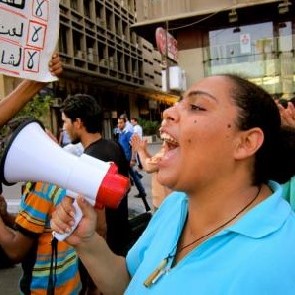
Rasha Azab is a journalist, screenwriter, and advocate for freedom of expression, freedom of assembly, and women's rights in Egypt. She co-founded the Kefaya movement in the mid-2000s, a grassroots coalition that challenged the authoritarianism of President Hosni Mubarak. Following the 2011 Arab Spring, she helped establish the No Military Trials for Civilians Movement, which campaigned against the military prosecution of civilians during the rule of the Supreme Council of the Armed Forces.
During that period, the military authorities brought her before a military court for reporting on forced virginity tests conducted on women detainees. Her work as a journalist and screenwriter has consistently focused on human rights abuses, gender-based violence, and the erosion of civil liberties in Egypt.
The Case: Solidarity with Survivors of Sexual Assault
In December 2020, six women published anonymous testimonies on the website Daftar Hekayat alleging sexual assault by Egyptian film director Islam Azazi. The platform provides a space for survivors to share their experiences without revealing their identities. Rasha Azab expressed support for the survivors on her personal Twitter account. She did not make allegations herself; she voiced solidarity with the women who came forward.
In January 2021, Islam Azazi filed a civil suit against Rasha accusing her of slander and defamation. The case was closed and dismissed in February 2021 because the allegations against her were deemed unsubstantiated. The following month, the director filed a grievance of financial damage, claiming that Rasha's statements had harmed his involvement with the Cairo International Film Festival. The case was reopened in March 2021. The director not only attended the festival but had his film screened there twice.
The case file was transferred to the Financial and Administrative Affairs Prosecution on 20 January 2022. Five days later, the Economic Court ordered Rasha to stand trial. Women's rights organizations raised concerns that the exceptional use of defamation and financial damage charges in a case involving sexual assault allegations would deter survivors and their supporters from speaking out.
Legal Proceedings and Acquittal
On 26 February 2022, Rasha appeared before the Public Prosecution in Al-Basatin, Cairo, on charges of slander, defamation, and financial damage. The prosecution relied on Penal Code No. 58 of 1937 and Communications Regulatory Law No. 10 of 2003. If convicted, she faced up to two years in prison and fines ranging from 20,000 to 500,000 Egyptian pounds. The hearing was adjourned until 12 March 2022.
On 23 April 2022, the Economic Court in Cairo acquitted Rasha Azab and dismissed all charges. The Court also rejected the civil suit brought by Islam Azazi and ordered him to bear the financial costs of the case. No credible investigation into the sexual assault allegations against Azazi was conducted by Egyptian authorities.
Prior Harassment
Rasha has faced judicial harassment for her human rights work before. On 13 October 2015, the Cairo Prosecutor interrogated her and five other activists for five hours on charges including organising an illegal protest, inciting people to protest, attacking police officers, blocking traffic, chanting slogans against the army and police, and belonging to an illegal organisation. The charges related to their involvement with the 6th of April Movement and the Revolutionary Socialists Movement. All six were released on bail the same day, and the charges were subsequently dropped.
Context and Impact
The prosecution of Rasha Azab occurred in an environment where Egyptian authorities routinely deploy defamation and cybercrime laws to silence dissent and punish speech about gender-based violence. The case demonstrated the risks faced by those who publicly support survivors of sexual assault in Egypt. The use of financial damage claims to reopen a previously dismissed case raised serious due process concerns. Rasha's acquittal marked a rare judicial pushback against this strategy of silencing, though the broader chilling effect on women's rights advocacy persists.
Sources on file with HuMENA EditorialReading time · 6 minutes
The prosecution of Rasha Azab for expressing solidarity with survivors sends a chilling message to all those seeking justice in cases of sexual violence.HuMENA Editorial · 2026
Take action.
Ways to act on Rasha Azab's case — chosen contextually from country, status, and your location.
Compiled by HuMENA's Egypt research team from primary documentation, public filings, family-supplied legal documents, and confidential partner reporting. Editorial responsibility: HuMENA Editorial Board.
Editorial sign-off · published